
Air Freight vs Sea Freight: Which Shipping Method Is Right for Your Cargo?

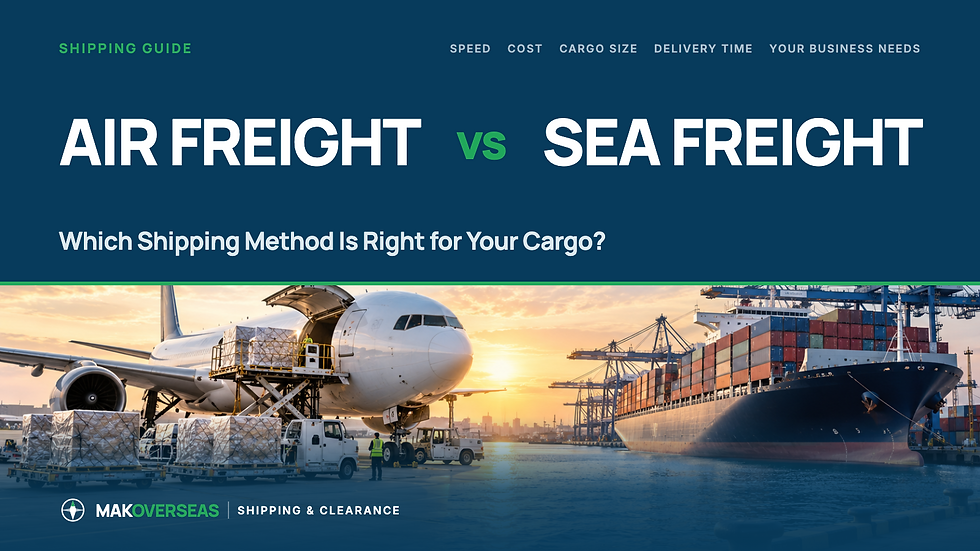
Choosing between air freight and sea freight is one of the most important decisions when planning an international shipment.
Air freight can be suitable when speed and timing are priorities, while sea freight is commonly considered for larger cargo volumes and containerized shipments.
But the right choice isn't simply about which method is faster or cheaper.
Your decision should consider:
Cargo type | Volume | Weight | Urgency | Budget | Origin | Destination
Here's how to compare them.
What Is Air Freight?
Air freight moves cargo internationally by aircraft.
It is particularly useful when transit time is important or when goods require faster transportation.
MAK Overseas provides air freight solutions including:
Express and standard air cargoReal-time shipment trackingTemperature-sensitive goodsUrgent shipments MAK_Overseas_Company_Profilevv2
Air freight may be suitable when:
Delivery time is a priority
The shipment is urgent
Cargo volume is relatively limited
Goods require closer timing coordination
The shipment is temperature-sensitive
What Is Sea Freight?
Sea freight transports goods internationally by vessel and is widely used for containerized and larger-volume cargo.
MAK Overseas' sea freight services include:
FCL — Full Container LoadLCL — Less than Container LoadPort-to-port shippingDoor-to-door shippingBreakbulk and oversized cargo MAK_Overseas_Company_Profilevv2
Sea freight may be suitable when:
You're shipping larger cargo volumes
Transit time is more flexible
Your shipment requires a full or partial container
You're moving heavy or oversized cargo
You are consolidating goods from multiple suppliers
Air Freight vs Sea Freight: What's the Difference?
Factor | Air Freight | Sea Freight |
Speed | Generally faster | Generally slower |
Cargo volume | Often smaller/time-sensitive shipments | Strong option for larger volumes |
Container options | Not FCL/LCL based | FCL and LCL available |
Oversized cargo | Depends heavily on aircraft/cargo requirements | Breakbulk/oversized solutions available |
Urgent shipments | Strong option | Less suited to urgent delivery |
Cost structure | Influenced heavily by weight/dimensions | Influenced by volume/container requirements |
Consolidation | Possible | FCL/LCL and supplier consolidation available |
There is no single shipping method that is right for every shipment.
Air Freight vs Sea Freight
Not necessarily in every situation.
Sea freight is often commercially attractive for larger shipments, while air freight can make sense when the cargo is smaller or when the cost of waiting outweighs the transportation difference.
For example, a business may value faster transportation when dealing with urgent inventory, production requirements or time-sensitive goods.
The correct comparison therefore isn't simply:
Air rate vs Sea rate
It should consider the total logistics requirement.
That can include freight, handling, customs clearance, delivery and the commercial impact of transit time.
How Important Is Shipment Size?
Very.
For larger volumes, sea freight provides options such as FCL and LCL.
With FCL, cargo uses dedicated container capacity.
With LCL, multiple shipments can share container space.
We've explained this in detail in our guide:
FCL vs LCL Shipping: Which Sea Freight Option Is Right for Your Cargo?
This should be an internal link to your already published Blog #1:
What If You're Buying From Multiple Suppliers?
You may not need to arrange a separate international shipment for every supplier.
MAK Overseas' consolidation service can bring multiple orders together before international transportation.
The documented process includes:
Receive → Inspect & Prepare → Consolidate → Ship & Clear MAK_Overseas_Company_Profilevv2
This can help reduce the number of separate shipments and simplify logistics and documentation.
Don't Forget Customs Clearance
Choosing air or sea freight is only one part of the shipping process.
International cargo may also require documentation, tariff classification, duty handling, inspection and compliance support.
MAK Overseas provides customs clearance services alongside its freight and logistics operations. MAK_Overseas_Company_Profilevv2
This allows the freight journey and customs process to be coordinated more closely.
Air Freight vs Sea Freight: How Should You Choose?
Before requesting a quotation, prepare these details:
1. OriginWhere will the cargo be collected or shipped from?
2. DestinationWhere does it need to arrive?
3. Cargo typeWhat exactly are you shipping?
4. WeightWhat is the total gross weight?
5. Dimensions / VolumeProvide carton, pallet or cargo dimensions where possible.
6. Ready dateWhen will the cargo be available?
7. Required delivery timingHow quickly do you need it?
These details allow the freight team to compare suitable transportation options.
Air or Sea? Let MAK Overseas Help You Decide
You don't need to select a shipping method before requesting a quotation.
Send MAK Overseas your shipment details:
Origin | Destination | Cargo | Weight | Dimensions | Ready Date | Required Delivery Time

Comments